
Sea Shanties, Sea Music, Sea Songs
What are sea shanties?
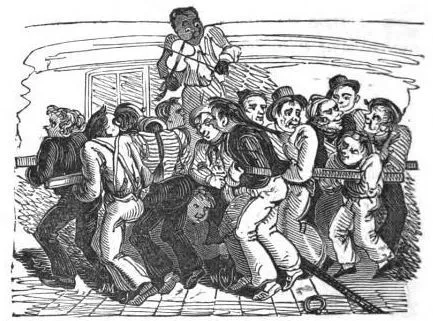
from The Quid. Public domain.
Sea shanties, also known as sea music or sea songs, are the work songs of the sea that helped sailors synchronize their hard and repetitive tasks, so they could labour more efficiently and safely. Singing sea shanties provided several benefits: a diversion for the mind, avoiding boredom, lightening the burden of mundane tasks, and expression of sailors' views which would otherwise not be tolerated.
"Shanties were labour songs sung by sailors of the merchant service only while at work, and never by way of recreation. Moreover—at least, in the nineteenth century—they were never used aboard men-o'-war, where all orders were carried out in silence to the pipe of the bo'sun's whistle.
Before the days of factories and machinery, all forms of work were literally manual labour, and all the world over the labourer, obeying a primitive instinct, sang at his toil: the harvester with his sickle, the weaver at the loom, the spinner at the wheel. Long after machinery had driven the labour-song from the land it survived at sea in the form of shanties, since all work aboard a sailing vessel was performed by hand.
The advent of screw steamers sounded the death-knell of the shanty. Aboard the steamer there were practically no sails to be manipulated; the donkey-engine and steam winch supplanted the hand-worked windlass and capstan. By the end of the seventies steam had driven the sailing ship from the seas. A number of sailing vessels lingered on through the eighties, but they retained little of the corporate pride and splendour that was once theirs. The old spirit was gone never to return."*
Basic sea shanty types
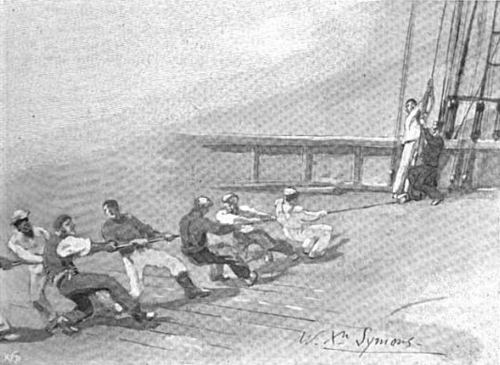
Illustration by W. Symons.
Public domain.
"Shanties may be roughly divided, as regards their use, into two classes: (_a_) Hauling shanties, and (_b_) Windlass and Capstan. The former class accompanied the setting of the sails, and the latter the weighing of the anchor, or 'warping her in' to the wharf, etc. Capstan shanties were also used for pumping ship. A few shanties were 'interchangeable,' i.e. they were used for both halliards and capstan. The subdivisions of each class are interesting, and the nature of the work involving 'walk away,' 'stamp and go,' 'sweating her up,' 'hand over hand,' and other types of shanty would make good reading; but nautical details, however fascinating, must be economized in a musical publication." * (More on shanty types and audio examples.)
Sea shanties and shanty houses — any connection?

St. Thomas, Dutch West Indies.
Public domain.
Here is a very interesting quote which asserts that there is: "West Indian negro shanties are movable wooden huts, and when a family wishes to change its venue it does so in the following manner: The shanty is levered up on to a low platform on wheels, to which two very long ropes are attached. The ropes are manned by as many hands as their length will admit. A 'shantyman' mounts the roof of the hut and sits astride it. He sings a song which has a chorus, and is an exact musical parallel of a seaman's 'pull-and-haul' shanty. The crowd below sings the chorus, giving a pull on the rope at the required points in the music, just as sailors did when hauling at sea. Each pull on the rope draws the hut a short distance forward, and the process is continued till its final resting-place is reached, when the shantyman descends from the roof. The hut is then levered off the platform on to terra firma and fixed in its required position.
Here, at least, we have a very ancient custom, which would be familiar to British seamen visiting West Indian seaports. The object moved was a shanty; the music accompanying the operation was called, by the negroes, a shanty tune; its musical form (solo and chorus) was identical with the sailor shanty; the pulls on the rope followed the same method which obtained at sea; the soloist was called a shantyman; like the shantyman at sea he did no work, but merely extemporized verses to which the workers at the ropes supplied the chorus; and finally, the negroes still pronounce the word itself exactly as the seaman did. I am quite aware of the flaws in the above argument, but at least it shows a manual labour act performed both afloat and ashore under precisely similar conditions as to (a) its nature, (b) its musical setting; called by the same name, with the same pronunciation in each case; and lastly, connected, in one case, with an actual hut or shanty." * (back to top)
* from The Shanty Book — Part I, by Richard Runciman Terry, London, 1921
Sea shanty articles
The Sea Shanty Revival of 2021Stan Hugill: The Last Working Shantyman